Five recipes for AI agents that pay per call. Each one pairs an x402 service with an InsumerAPI check, so the agent acts on a signed answer and keeps it. Every recipe here ran for real on 10 November 2026.
Five live runs on Base. $5.62 in total, including a $5 gift card we redeemed.
x402 moves the money. InsumerAPI checks the conditions.
Updated
Where the InsumerAPI check comes first, a no ends the recipe and the agent spends nothing more. Every InsumerAPI answer is signed twice: ES256 and a post-quantum ML-DSA-65 signature. Anyone can verify it against our published keys.
Recipe 1
Outcome: an agent gives a gift card, eSIM or phone top-up only to members whose wallets meet a rule: holding a member pass issued by Skye Meta's Bothy, an NFT, or a number of tokens. The member gets the reward. The agent keeps a signed record of why.
POST /v1/attest $0.05Does that wallet meet the rule? A no ends the recipe.GET /x402/gift-cards/search $0.002Find the reward for the member's country.POST /x402/invoice/create $0.002Lock the price.POST /x402/invoice/pay the rewardPay for the reward.GET /x402/invoice/status freeThe agent signs in with the wallet that paid and collects the code, then sends it privately to the member.{
"wallet": "0xMEMBER_WALLET",
"format": "jwt",
"conditions": [{
"type": "token_balance",
"chainId": 8453,
"contractAddress": "0x833589fCD6eDb6E08f4c7C32D4f71b54bdA02913",
"threshold": "1",
"label": "Holds 1 USDC on Base"
}]
}For a pass or any other NFT, use "type": "nft_ownership" with the pass's contract address.
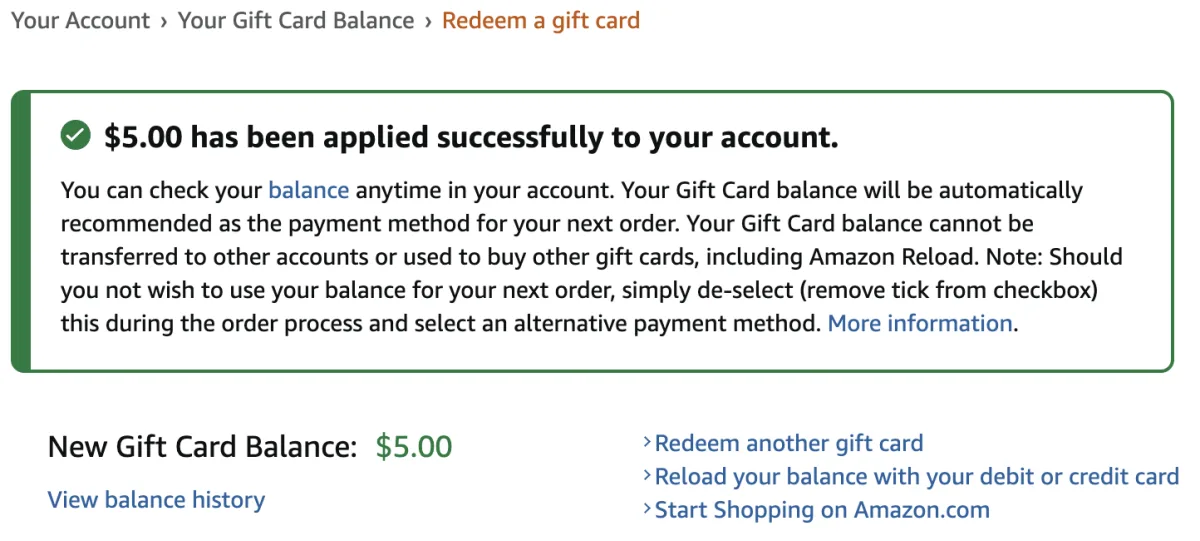
The member signed a challenge and the agent verified it. The rule was "holds at least 1 USDC on Base", and InsumerAPI answered yes (attestation ATST-96EC936E40A1815C, the signed answer). Bitrefill priced a $5 Amazon.com gift card at $5.25 and took payment. About 3 seconds later the agent signed in with its paying wallet, collected the code and handed it to the member. In this run the member and the agent were both us, so we redeemed the card ourselves:
Payments: check · search · invoice · gift card
Total: $5.304 ($0.054 in calls, $5.25 for the card)
Why both: Bitrefill sells the reward with no account and no card number. InsumerAPI decides who gets one, and the signed answer explains every payout.
Recipe 2
Outcome: before paying another agent for a job, the agent confirms it is a registered ERC-8004 agent and, at that moment, holds a set multiple of the job's value.
GET /v1/reputation?chain=base&subject=AGENT_ID $0.002ERC-8004 reviews, with reviewers that share a funder counted once.POST /v1/attest $0.05Owns the agent, and holds 10 times the job in USDC? Two conditions, one signed answer.{
"wallet": "0xAGENT_OWNER_WALLET",
"format": "jwt",
"conditions": [
{ "type": "erc8004_agent", "chainId": 8453, "agentId": "AGENT_ID",
"label": "Owns the ERC-8004 agent" },
{ "type": "ratio_to_amount", "chainId": 8453,
"contractAddress": "0x833589fCD6eDb6E08f4c7C32D4f71b54bdA02913",
"multiple": "10", "amount": "1",
"label": "Holds 10x a $1 job in USDC" }
]
}The erc8004_agent check passes for the agent's owner or for the wallet the registry binds to the agent. If your rule is ownership, also require "matchedVia": "owner" in the result.
We checked an agent registered on Base. Its reviews looked healthy: 50 reviews from 25 separate clients, none flagged. InsumerAPI answered no (attestation ATST-FD82C408ECD891D6): the wallet owns the agent (matchedVia: "owner"), but it does not hold 10 times a $1 job. So our agent did not hire it, and paid nothing for the job.
Total: $0.052
Why both: reviews tell the agent how others rated past work. The attestation tells it what the other agent holds at the moment of hiring. It is a check at one moment, not a bond or escrow. Selling to agents instead of hiring them? See how to check an AI agent before it pays you. Why this run matters: what x402 doesn't tell your agent.
Recipe 3
Outcome: the agent enforces "holds at least $100 of WETH" and gets a signed yes or no.
GET /api/v3/x402/onchain/simple/networks/base/token_price/TOKEN $0.005Today's price. Divide the dollar rule by it and round up, so the threshold is never below the rule.POST /v1/attest $0.05The token amount becomes the threshold.{
"wallet": "0xWALLET",
"format": "jwt",
"conditions": [{
"type": "token_balance",
"chainId": 8453,
"contractAddress": "0x4200000000000000000000000000000000000006",
"threshold": "0.0484202881007142",
"label": "Holds $100 of WETH at 2065.25"
}]
}CoinGecko priced WETH on Base at $2,065.25. $100 divided by that, rounded up to 18 decimals, is 0.0484202881007142 WETH. InsumerAPI answered yes (attestation ATST-53D6AF1844B42282). The price went into the condition's label, which is carried inside the signed answer, so the answer records the price the rule was based on. Keep the CoinGecko response alongside it as the source of that price.
Data powered by CoinGecko API
Total: $0.055
Why both: InsumerAPI thresholds are token amounts. CoinGecko turns a dollar rule into one.
Recipe 4
Outcome: before dealing with a wallet, the agent has its standing with people and signed facts about its holdings.
GET /x402/user/address/WALLET $0.001Profile, linked X account and a credibility score built from reviews and vouches.POST /v1/trust $0.15A signed fact profile across 10 dimensions. No score, no opinion, just cryptographically verifiable evidence organized by dimension.{ "wallet": "0xWALLET" }For vitalik.eth, Ethos returned a credibility score of 1313. InsumerAPI returned a signed fact profile (TRST-96204): 155 checks, 45 passed, with activity in 8 of 10 dimensions.
Total: $0.151
Why both: Ethos tells the agent how people rate the wallet's owner. InsumerAPI tells it what the chain shows, signed.
Recipe 5
Outcome: an agent that offers paid search or data spends on it only when the requesting wallet meets the rule.
POST /v1/attest $0.05Does the requesting wallet qualify? If your policy checks the paying wallet, use the verified x402 payer address for this request. If it checks a different wallet, require a signed challenge from that wallet first. Never trust an address the requester only typed in. A no ends the recipe.POST /search $0.007The research, bought only after the answer is verified. Any paid search or data service on x402 fits here.recipe-5.mjs is the whole recipe in one file. It caps each payment and pays only the expected payees. Before spending anything on Exa, it verifies the signed answer offline against the saved public keys (both signatures, condition hashes, freshness and expiry), requires the post-quantum signature to verify, and checks the answer is about the requesting wallet.
npm install viem insumer-verify @noble/post-quantum curl -o jwks.json https://insumermodel.com/.well-known/jwks.json PRIVATE_KEY=0x... node recipe-5.mjs --dry # quotes and signs, sends nothing PRIVATE_KEY=0x... node recipe-5.mjs # spends $0.057 in USDC on Base
The key is your agent's wallet on Base. It needs a little USDC and no ETH.
The rule was "holds at least 1 USDC on Base". InsumerAPI answered yes (attestation ATST-E05CCFF289C57939). The answer verified offline and named the requesting wallet, so the agent paid Exa, which returned five results. The signed answer is published as it came back. Its meta.settlementTx names the payment that bought it. That field is payment metadata outside the signed attestation, so check it against Basescan, not against the signature.
Total: $0.057
Why both: the research is what the agent sells. The check decides who gets it and records why.
Each call is a plain HTTP request. The first response is a 402 with the price. The agent signs a USDC payment and sends the same request again. InsumerAPI needs no API key on this path and takes USDC on Base, Polygon, Arbitrum, Arc or Solana. The payer is charged only for a successful answer, and the payer sees the answer only after the payment settled.
To check a published answer yourself, offline: download it and our public keys once, then verify with nothing fetched. Read the verdicts one by one. Every answer expires 30 minutes after it was signed, so after that v.valid is false even though both signatures still verify.
curl -O https://insumermodel.com/x402-cookbook/evidence/recipe-5-attestation.json curl -o jwks.json https://insumermodel.com/.well-known/jwks.json npm install insumer-verify @noble/post-quantum node verify.mjs
import { verifyAttestation } from "insumer-verify";
import fs from "node:fs";
// Both files downloaded once. Nothing is fetched below.
const answer = JSON.parse(fs.readFileSync("recipe-5-attestation.json", "utf8"));
const jwks = JSON.parse(fs.readFileSync("jwks.json", "utf8"));
const v = await verifyAttestation(answer, { jwks, mode: "evidence" });
console.log("ES256 signature verified:", v.checks.signature.passed);
console.log("ML-DSA-65 signature:", v.checks.pq.status);
console.log("Condition hashes match:", v.checks.conditionHashes.passed);
console.log("Still within its 30 minutes:", v.checks.expiry.passed);The projects in these recipes: Bitrefill, trust-agent.io, CoinGecko, Ethos, Exa and Skye Meta's Bothy.
The five recipes cost $5.62 to run, $5.25 of it for the gift card. Prices for other services are what each one charged on 10 November 2026 and may change. The services named here are independent companies: each recipe calls their public x402 endpoints, and no partnership is implied. Skye Meta, which makes Bothy, builds on InsumerAPI.